
| Golden Sun Moth (one synonym: Synemon hesperioides R. Felder, 1874) CASTNIIDAE, SESIOIDEA | (donherbisonevans@yahoo.com) and Stella Crossley |
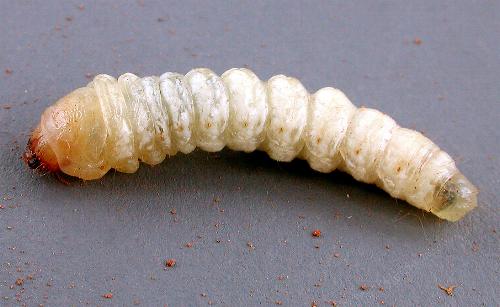
(Photo: courtesy of David McClenaghan, CSIRO)
|
| Golden Sun Moth (one synonym: Synemon hesperioides R. Felder, 1874) CASTNIIDAE, SESIOIDEA | (donherbisonevans@yahoo.com) and Stella Crossley |
(Photo: courtesy of David McClenaghan, CSIRO)
The Caterpillars of this species are off-white with a black head, and a red collar. The caterpillars are thought to feed on the roots of various grasses (POACEAE), including :
The caterpillars pupate in silk-lined tunnels beside their foodplant.
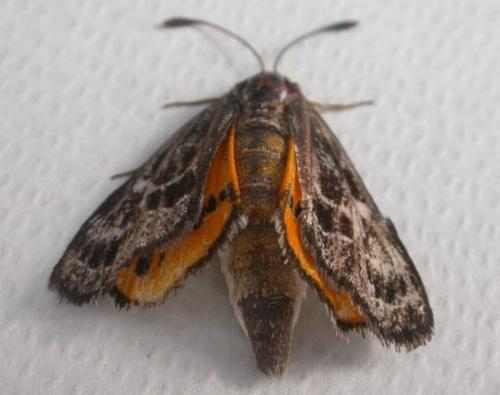
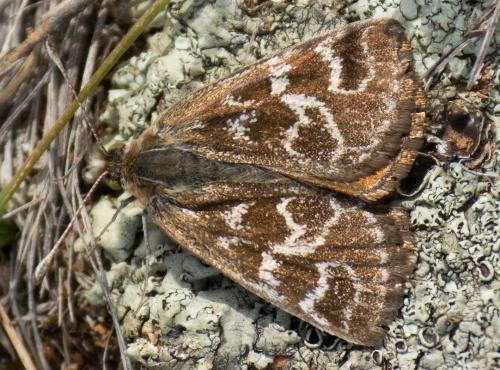
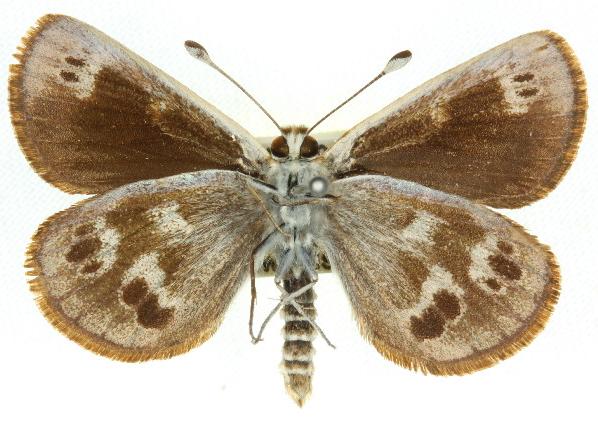
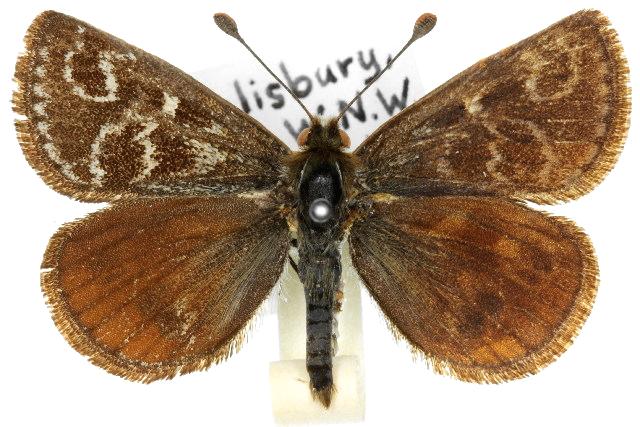
The adult moths have brown forewings, each with some white markings including two wiggly white irregular squares. The hindwings of the male are orange-brown with some vague dark spots. The undersides of the male are brown with white outlined dark markings.
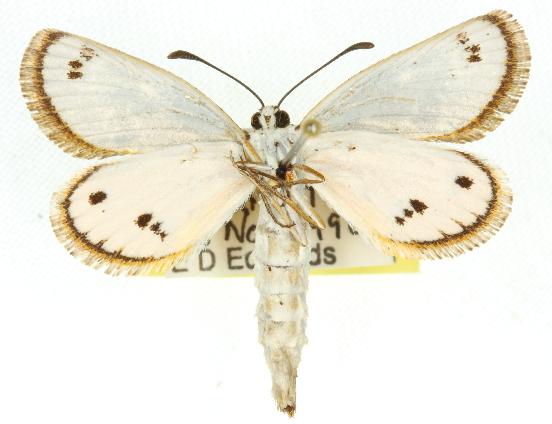
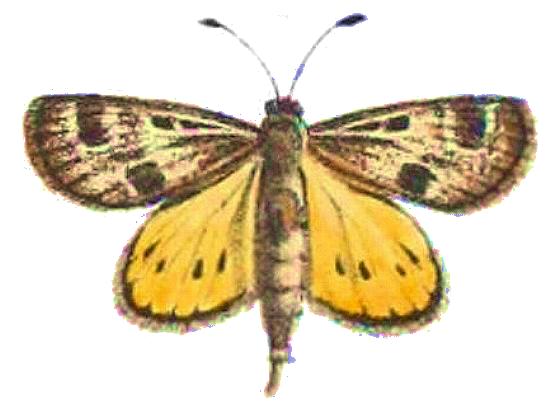
The hindwings of the female are pale orange or yellow, with variable brown spots. The undersides of the female are white with brown margins and spots.
The females, although they have wings, are too heavy to fly, and commonly sit displaying their orange hindwings, presumably awaiting discovery by passing males.
The species has been found in
This species is considered to be endangered. Its status is being extensively studied.
Further reading :
Michael S. Braby & M. Dunford,
Field Observations on the ecology of the Golden Sun Moth
Synemon plana Walker (Lepidoptera: CASTNIIDAE),
The Australian Entomologist
Volume 33, Part 2 (June 2006), pp. 103-110.
Ian F.B. Common,
Moths of Australia,
Melbourne University Press, 1990, pls. 6.15, 6.16, pp. 284-285.
Francis Walker,
Catalogue of Lepidoptera Heterocera,
List of the Specimens of Lepidopterous Insects in the Collection of the British Museum,
Part 1 (1854), p. 37, No. 5.
Paul Zborowski and Ted Edwards,
A Guide to Australian Moths,
CSIRO Publishing, 2007, pp. 26, 104.
 caterpillar |  butterflies |  Lepidoptera |  moths |  caterpillar |
(updated 23 April 2013, 27 September 2025)