
| (previously known as Nyctipao terminitincta) CATOCALINI, EREBIDAE, NOCTUOIDEA | (donherbisonevans@yahoo.com) and Stella Crossley |

early instar, magnified
(Photo: courtesy of
Craig Nieminski, Darwin, Northern Territory)
|
| (previously known as Nyctipao terminitincta) CATOCALINI, EREBIDAE, NOCTUOIDEA | (donherbisonevans@yahoo.com) and Stella Crossley |
early instar, magnified
(Photo: courtesy of
Craig Nieminski, Darwin, Northern Territory)
Initially this Caterpillar is patchy brown with orange knobs sticking out of the back and sides. There are some white marks on the last two segments. The caterpillar is missing 2 pairs of prolegs. The caterpillars have been found feeding on

Later instars have orange spots along the sides and still have some orange dorsal appendages.

The mature caterpillar is a patchy brown, and its head and true legs are a rusty brown colour. Only the first abdominal segment has a pair of orange spots.

The cocoon is dense and made of pale brown silk. It is created amongst the dead leaves and stems of the foodplant.

The adult moths have dark brown wings, with a ragged white arc across each wing. There is an eyespot on each forewing, and a white mark at the tip of each hindwing.

The species occurs in:
Further reading :
Ian F.B. Common,
Moths of Australia,
Melbourne University Press, 1990, fig. 45.9, p. 455.
Max Gaede,
Macrolepidoptera of Indo-Australian Fauna.: Noctuiform Phalaenae, Acontiinae,
in Adalbert Seitz (ed.):
The Macrolepidoptera of the World,
Stuttgart : Alfred Kernen Verlag, Volume 11 (1938), p. 462.
 caterpillar |  butterflies | 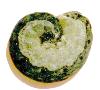 Lepidoptera |  moths |  caterpillar |
(updated 12 September 2011, 14 November 2015, 15 February 2019, 11 July 2021)