
| Hemlock Moth (also known as : Agonopterix alstromeriana Linnaeus, 1788) DEPRESSARIINAE, DEPRESSARIIDAE, GELECHIOIDEA | (donherbisonevans@yahoo.com) and Stella Crossley |

early instar
(Photo: courtesy of
Elaine McDonald, Nicholls Rivulet, Tasmania)
|
| Hemlock Moth (also known as : Agonopterix alstromeriana Linnaeus, 1788) DEPRESSARIINAE, DEPRESSARIIDAE, GELECHIOIDEA | (donherbisonevans@yahoo.com) and Stella Crossley |
early instar
(Photo: courtesy of
Elaine McDonald, Nicholls Rivulet, Tasmania)
The Caterpillar of this species is initially yellow with a black head, and a brown collar. Later instars become green with three dark stripes along the body, and a yellowish head.

The caterpillar lives in a shelter created from rolled leaves and flowers of its foodplant, and feeds on:
The caterpillar grows to a length of about 1 cm. It pupates in the soil. The pupa is rusty brown, with tufts of hair.

The adult moth has pale fawn forewings, each with various markings including an orange-edged black patch at the middle of the costa. The hindwings are off-white shading to pale brown at the wingtips. The wingspan is about 2 cms.

The female moth lays a total of about 200 small pale eggs on the undersides of foodplant leaves.
The species over-winters as the adult moth. It is possible that the moths retain poison from their foodplant, and are unpalatable to possible predators.

The species was originally found in Europe, including
but has been introduced into other countries, some accidentally, and some deliberately, to control the poisonous Hemlock plant which can kill grazing cattle. So the moth can now also be found in
as well as in Australia in

Further reading:
Carl Alexander Clerck,
Icones insectorum rariorum : cum nominibus eorum trivialibus, locisque,
Sectio Prima (1759), view 10.
 caterpillar |  butterflies | 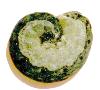 Lepidoptera |  moths |  caterpillar |
(written 9 August 2019, updated 5 October 2025)