
| (one synonym : Anua clementi Swinhoe, 1918) Green Drab EREBINAE, EREBIDAE, NOCTUOIDEA | (donherbisonevans@yahoo.com) and Stella Crossley |
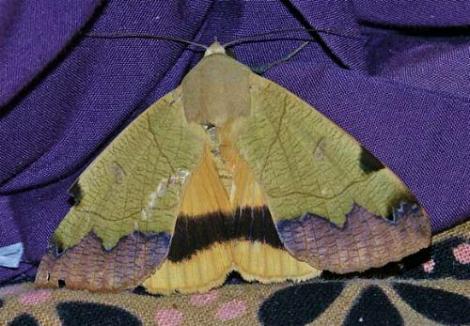
male
Photo: courtesy of Buck Richardson, from
Tropical Queensland Wildlife from Dusk to Dawn Science and Art
|
| (one synonym : Anua clementi Swinhoe, 1918) Green Drab EREBINAE, EREBIDAE, NOCTUOIDEA | (donherbisonevans@yahoo.com) and Stella Crossley |
male
Photo: courtesy of Buck Richardson, from
Tropical Queensland Wildlife from Dusk to Dawn Science and Art
The Caterpillars of this species have been found feeding on plants from a variety of families, including
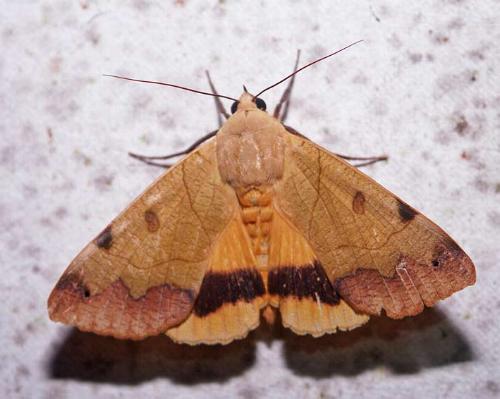
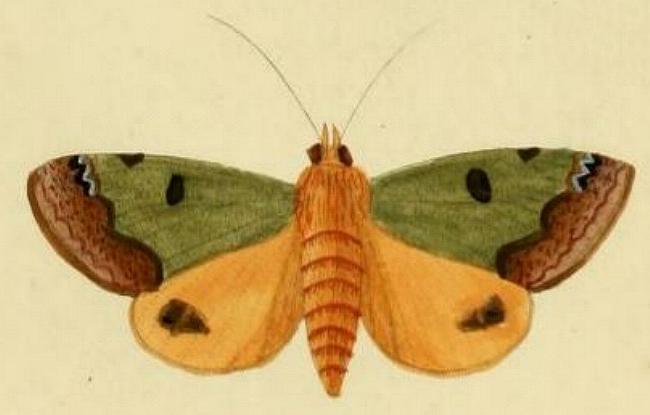
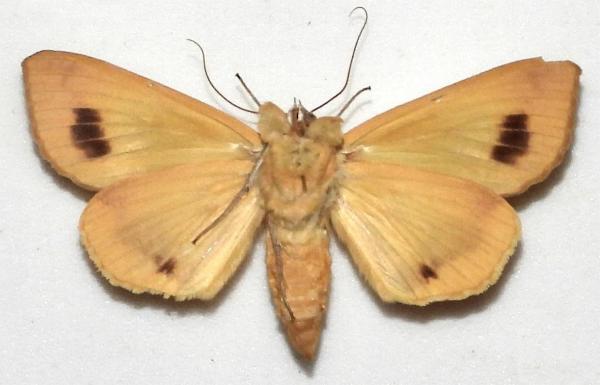
The female adult moth has brown forewings, each with a darker broad irregular band along the margin, a dark spot near the middle, and a black mark about halfway along the costa.
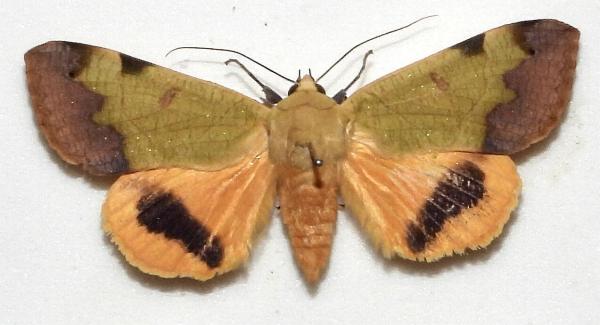
The male adult moth has greenish forewings, each with a pattern similar to that of the female
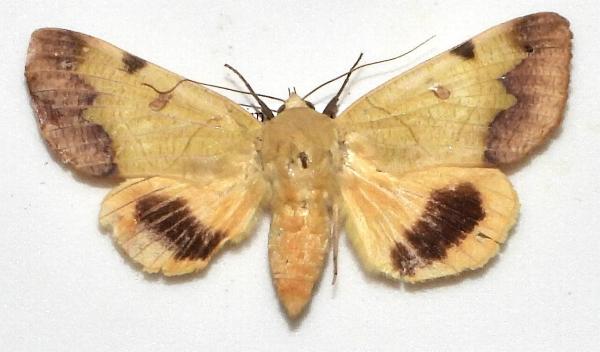
The hindwings of both sexes are yellow, each having a broad but broken dark submarginal band. The wingspan is about 7 cms.
The species has been found in :
as well as in Australia in
Further reading :
Pieter Cramer,
Description de Papillons Exotiques,
Uitlandsche kapellen voorkomende in de drie waereld-deelen,
Amsterdam Baalde, Volume 2 (1777), p. 116, and also
Plate 172, fig. E.
Peter Marriott,
Moths of Victoria - Part 8,
Night Moths and Allies - NOCTUOIDEA(B),
Entomological Society of Victoria, 2017, pp. 22-23.
Buck Richardson,
Tropical Queensland Wildlife from Dusk to Dawn Science and Art,
LeapFrogOz, Kuranda, 2015, p. 146.
Paul Zborowski and Ted Edwards,
A Guide to Australian Moths,
CSIRO Publishing, 2007, p. 23.
 caterpillar |  butterflies |  Lepidoptera |  moths |  caterpillar |
(updated 26 October 2011, 1 November 2025)