(Photo: courtesy of
Merle Shepard, Gerald R.Carner, P.A.C Ooi and Bugwood.org
Insects and their Natural Enemies Associated with Vegetables and Soybean in Southeast Asia)
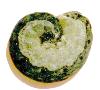
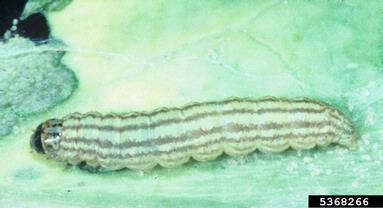
The caterpillars of this species are pale greenish-brown with several
dark lines along the body.
The head is very dark brown.
The caterpillars are an agricultural pest on crops in the Cabbage family
(BRASSICACEAE),
particularly:
Head Cabbage ( Brassica oleracea var. capitata ),
Chinese Cabbage ( Brassica rapa var. pekinensis ), and
Mustard Cabbage ( Brassica juncea ).
The caterpillars initially bore into the stem of growing shoots,
later instars feeding in the leaves and leaf stems.
The caterpillars make a web of silk around their feeding area which
accumulates frass.
Pupation has been found within the silken shelter.
(Photo: courtesy of
Graeme Cocks, Townsville, Queensland)
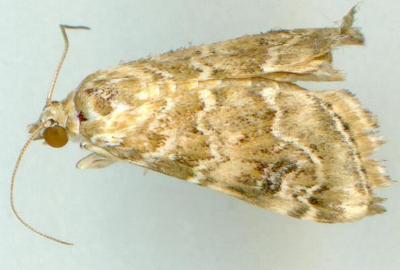
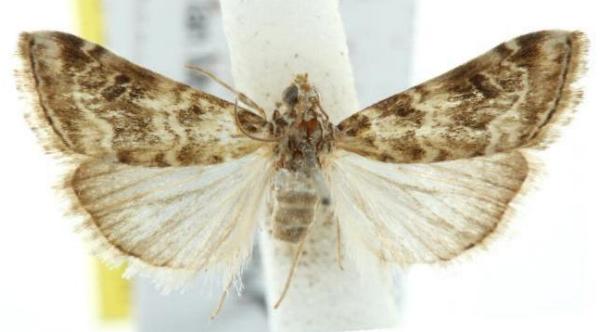
Adult moths have fawn forewings, each with sinuous pale lines
and a kidney-shaped mark.
The hindwings are a uniform grey darkening at the margins.
The wingspan is about 2 cms.
(Photo: courtesy of the Photography Group,
Centre for Biodiversity Genomics,
University of Guelph)
The pheromones
have been determined and are used in
Integrated Pest Management techniques for this species.
The species has been found from Europe across Asia to
the Pacific, including :
Canary Islands,
Cook Islands,
Hawaii,
India,
Italy,
Singapore,
South Africa,
as well as in Australia in
Northern Territory,
Queensland,
New South Wales,
Lord Howe Island,
Norfolk Island,
Victoria, and
South Australia.
Further reading :
Ian F.B. Common,
Moths of Australia,
Melbourne University Press, 1990, pp. 66, 354.
Johan Christian Fabricius,
Species Insectorum Exhibentes eorum Differentias specificas,
Hamburg & Kilonii : C.E. Bohnii, Volume 2, Part viii (1781), p. 272, No. 178
Peter B. McQuillan, Jan A. Forrest, David Keane, & Roger Grund,
Caterpillars, moths, and their plants of Southern Australia,
Butterfly Conservation South Australia Inc., Adelaide (2019), p. 85.
Paul Zborowski and Ted Edwards,
A Guide to Australian Moths,
CSIRO Publishing, 2007, p. 133.
(updated 22 January 2013, 26 August 2019, 13 September 2020)