
| Ornate Dusk-flat (previously known as Netrocoryne denitza) PYRGINAE, HESPERIIDAE, HESPERIOIDEA | (donherbisonevans@yahoo.com) and Peter R. Samson & Stella Crossley |
(Photo: courtesy of David Johnston,
Jove Creative Publishing P/L)
|
| Ornate Dusk-flat (previously known as Netrocoryne denitza) PYRGINAE, HESPERIIDAE, HESPERIOIDEA | (donherbisonevans@yahoo.com) and Peter R. Samson & Stella Crossley |
(Photo: courtesy of David Johnston,
Jove Creative Publishing P/L)
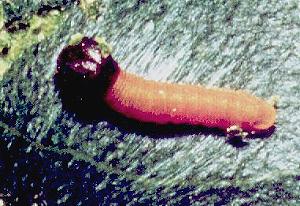
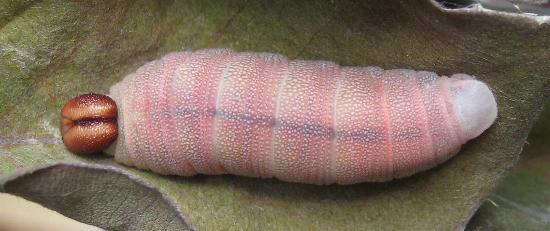
These caterpillars initially are orange with a black head. Later instars become pink with a pale thorax and anal plate. They have a dark line down the back. They live in a shelter made by cutting a piece of leaf and folding it over and joining it with silk. They cling to the roof of their shelter upside-down by day, coming out to feed in the evening.
They have been found feeding on the foliage of various trees in MYRTACEAE, including:
The caterpillars pupate in their shelter.
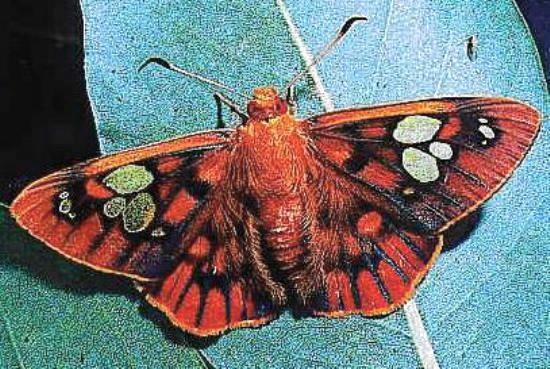
The adult butterflies are rusty brown, with blurred dark markings and pale yellow spots on the wings.
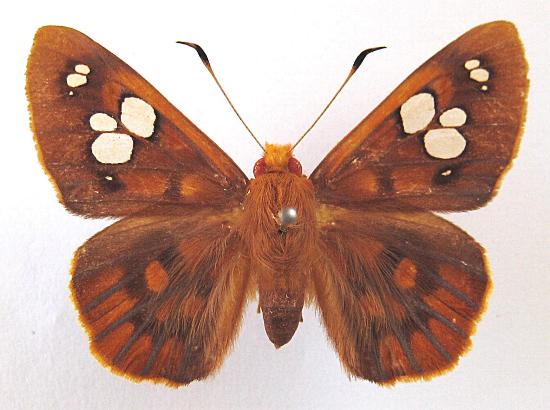
The eyes are red. The wings have a purple suffusion, especially the females, which are usually larger than the males. The males have a wingspan of about 4 cms. The females have a wingspn of about 6 cms.
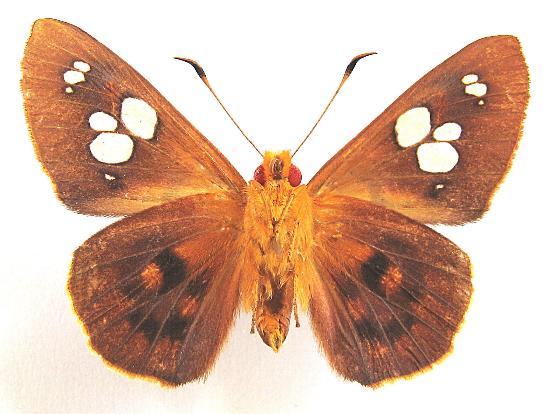
The undersides are similar to the upper surfaces.
The eggs are brown and dome shape, laid singly on the upper surface of a leaf of a food plant.
This species has been found sporadically over the north of Australia, including
Further reading :
Michael F. Braby,
Butterflies of Australia,
CSIRO Publishing, Melbourne 2000, vol. 1, pp 64-65.
William Chapman Hewitson,
Hesperidae,
Descriptions of One Hundred new species of Hesperidae,
London, Part 1 (1867), p. 22, No. 2.
David Lane,
A New and Interesting Foodplant Record for the Rare Red Eye
(Lepidoptera : Hesperiidae : Pyrginae),
Butterflies and Other Invertebrates Club,
Metamorphosis Australia,
Issue 56 (March 2010), pp. 12-13.
 caterpillar |  butterflies |  Lepidoptera |  moths |  caterpillar |
(updated 22 January 2012, 14 May 2025)