
| Green Purse Gum Snout Moth (previously known as Lebeda apicalis) LASIOCAMPINAE, LASIOCAMPIDAE, BOMBYCOIDEA | (donherbisonevans@yahoo.com) and Stella Crossley |
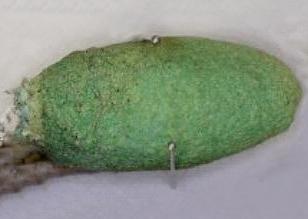
cocoon
(Photo: courtesy of Peter Marriott,
Moths of Victoria - Part 1)
|
| Green Purse Gum Snout Moth (previously known as Lebeda apicalis) LASIOCAMPINAE, LASIOCAMPIDAE, BOMBYCOIDEA | (donherbisonevans@yahoo.com) and Stella Crossley |
cocoon
(Photo: courtesy of Peter Marriott,
Moths of Victoria - Part 1)
The species is unusual as the Caterpillar uses green silk to make its cocoon, which it hangs from a twig of the foodplant.
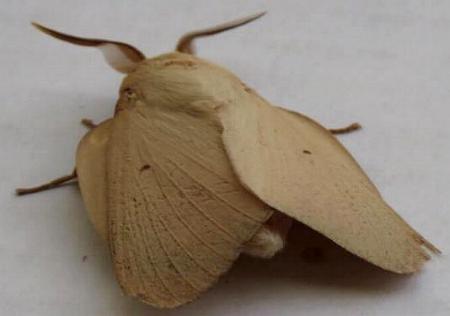
The adult moths have brown wings with faint darker markings, including a darker spot near the centre of each forewing. The hindwings tend to orange. At rest, the hindwings protrude from under the forewings.
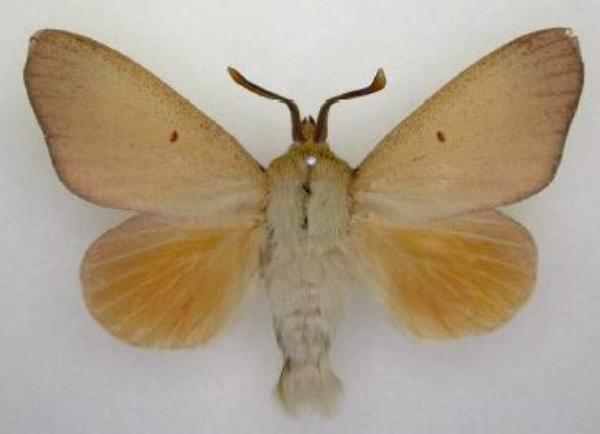
The males are smaller than, and have similar coloration to, the females, but have forewings that have a concave margin, and less obvious darker markings, except for the forewing dark spot. The males have feathery antennae, and the females have thread-like antennae. The females have a much fatter abdomen. The wingspan of the males is about 5 cms. The wingspan of the females is about 7 cms.
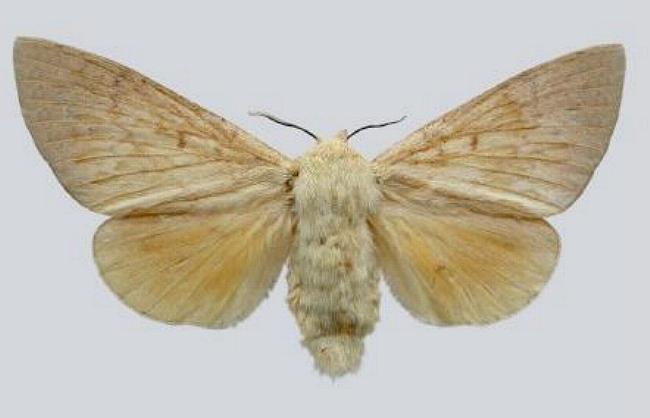
The species has been found over much of Australia, including:
Further reading :
Ian F.B. Common,
Moths of Australia,
Melbourne University Press, 1990, pl. 27.14, p. 390.
Peter Marriott,
Moths of Victoria - Part 1,
Silk Moths and Allies - BOMBYCOIDEA,
Entomological Society of Victoria, 2008, pp. 10-11.
A. Jefferis Turner,
Revision of Australian Lepidoptera. Lasiocampidae.,
Proceedings of the Linnean Society of New South Wales,
Volume 49 (1924), p. 420-421, No. 38.
 caterpillar |  butterflies | 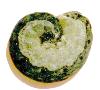 Lepidoptera |  imagoes |  caterpillar |
(updated 22 March 2009, 21 August 2020, 24 March 2021)