
| Jean Louis Denis Coutant (1776-1831) |
|
| Jean Louis Denis Coutant (1776-1831) |
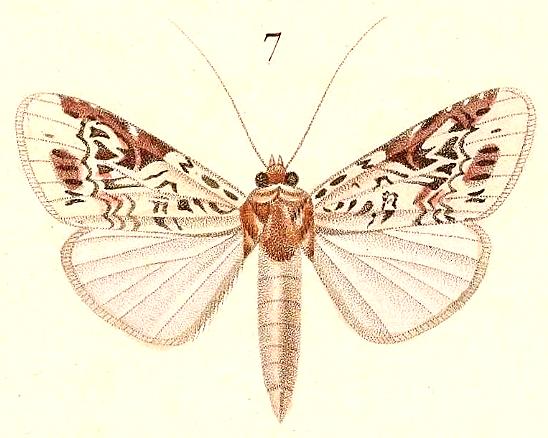 Spodopter picta | 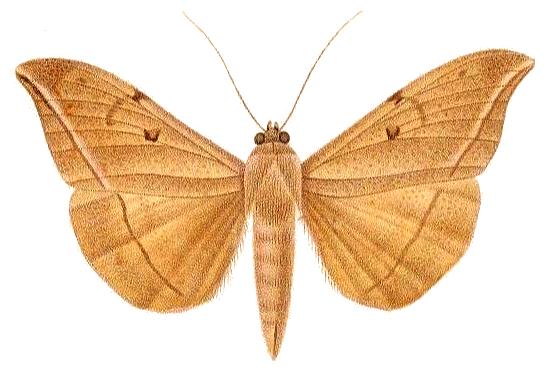 Hamodes propitia | 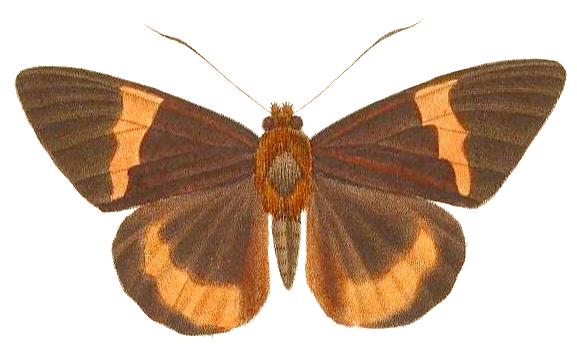 Chaetocneme critomedia | 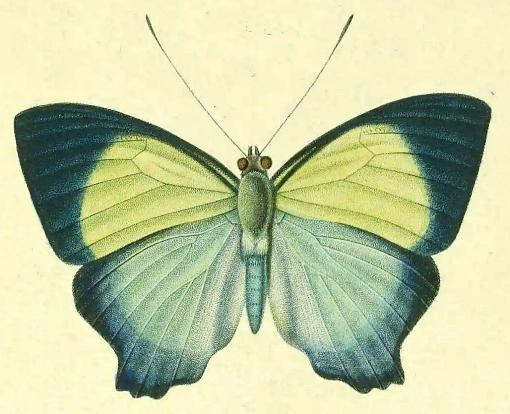 Symbrenthia geoffroyi |
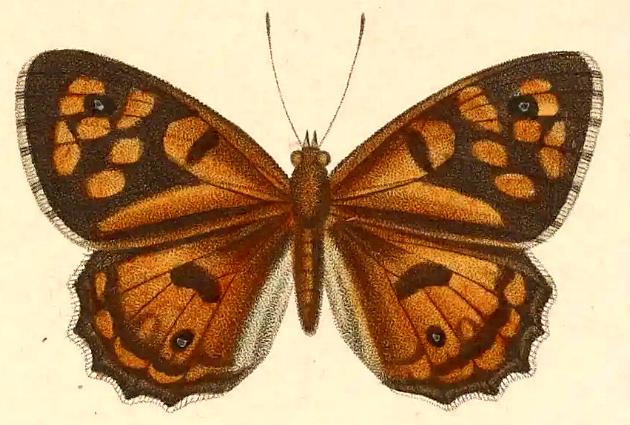 Geitoneura klugii |
Coutant was a highly skilled French draughtsman and engraver who specialized in natural history, particularly ornithology (birds), ichthyology (fish), entomology (insects), and anthropology. Operating during the Age of Enlightenment and the Romantic era, Coutant became one of France's premier scientific printmakers. He is best remembered as the chief engraver for the official publications documenting major French voyages of global exploration.
Rather than generating original art from nature himself, Coutant worked primarily as a master printmaker.
Coutant was prominently contracted by the French government to translate field drawings from
historical scientific expeditions into masterfully detailed copper plates for official publication.
His key focus was scientific illustrations, including birds, insects, marine life and anthropology.
Besides wildlife, Coutant translated early scientific and racial theories like phrenology, into print,
notably engraving plates such as the Crânes de Papous (Papuan Skulls, 1824) based on drawings by Antoine Chazal.
He collaborated with the era's most celebrated field painters and naturalists,
converting their watercolors into sharp, consistent, reproducible lines.
He regularly worked alongside renowned illustrators such as Antoine-Germain Bévalet, Jean-Gabriel Prêtre, Paul-Louis Oudart,
and Antoine Chazal, and expedition naturalists like René Primevère Lesson and Jean René Constant Quoy.
Many of his plates were printed by the famous Paris-based printer Narcisse Claude Julien Rémond.
Today, original prints of Coutant's work are highly collectible and can be found in major institutional collections,
including the National Library of New Zealand, the Victoria and Albert Museum, and the Library of Congress.
Major Works on French Global Voyages:
The Voyage of La Coquille (1822-1825): Under the command of Louis Isidore Duperrey, this expedition amassed a massive collection of Pacific flora, fauna, and anthropological records. Coutant served as the chief engraver for the massive multi-volume atlas, Voyage autour du monde. He painstakingly engraved the natural history plates, including iconic illustrations of New Zealand and Tahitian birds (such as the North Island saddleback), and illustrations of Lepidoptera from each location with the entomologist Félix Édouard Guérin-Méneville.
The Voyage of L'Uranie (1817-1820): Commanded by Louis de Freycinet, Coutant engraved several scientific findings from this global circumnavigation, particularly focused on West Papua and Pacific islands
(courtesy of Google AI)
 butterflies |  Lepidoptera |  artists |  moths |