
| ODONTIINAE, CRAMBIDAE, PYRALOIDEA | (donherbisonevans@yahoo.com) and Stella Crossley |
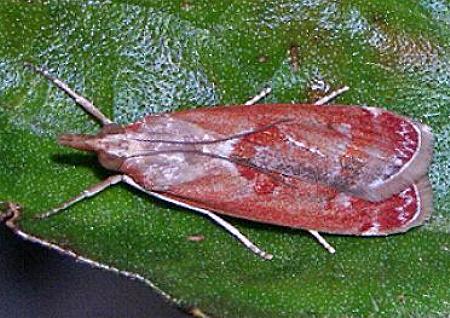
(Photo: courtesy of Buck Richardson, Kuranda, Queensland)
|
| ODONTIINAE, CRAMBIDAE, PYRALOIDEA | (donherbisonevans@yahoo.com) and Stella Crossley |
(Photo: courtesy of Buck Richardson, Kuranda, Queensland)
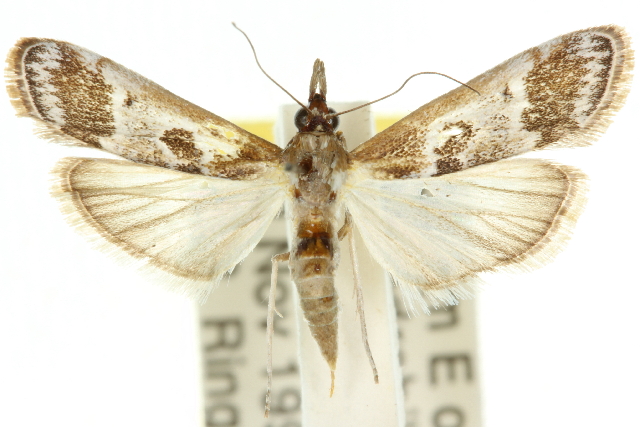
The moths of this species have variable brown or off-white forewings, each sometimes with a brown or rusty submarginal band, sometimes another brown or rusty patch on the hind margin, and always with an arc of small dark triangles along the margin. The hindwings are white with brown veins and margins. The wingspan is about 2.5 cms.
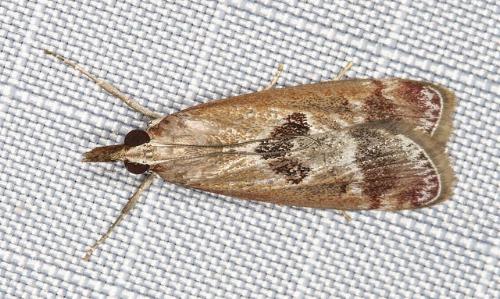
In the evening, the male moths are inclined to rest high in bushes, and make high pitched noises by rubbing parts of their abdomen against each other, probably to attract females. The male moths also have a bunch of hairs on the tip of the abdomen which emit pheromones. While resting, the male moths fan their wings so dispersing this scent, presumably also to attract females.
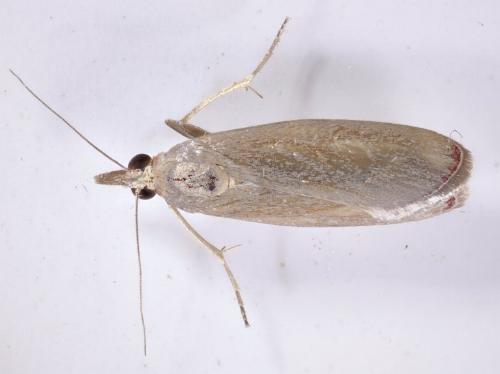
The species has been found across the west Pacific, including:
as well as most of Australia, including:
Further reading :
Ian F.B. Common,
Moths of Australia,
Melbourne University Press, 1990, fig. 33.14, pp. 50, 354.
Edward Meyrick,
Descriptions of Additional Australian Pyralidina,
Proceedings of the Linnean Society of New South Wales,
Series 2, Volume 4, Part 4 (1890), p. 1107.
Buck Richardson,
Tropical Queensland Wildlife from Dusk to Dawn Science and Art,
LeapFrogOz, Kuranda, 2015, p. 31.
Paul Zborowski and Ted Edwards,
A Guide to Australian Moths,
CSIRO Publishing, 2007, p. 135.
 caterpillar |  butterflies |  Lepidoptera |  moths |  caterpillar |
(written 6 November 2010, updated 10 November 2025)