
| (previously known as Tyspana vitessoides) ODONTIINAE, CRAMBIDAE, PYRALOIDEA | (donherbisonevans@yahoo.com) and Stella Crossley |
(Photo: courtesy of
Roger Kendrick)
|
| (previously known as Tyspana vitessoides) ODONTIINAE, CRAMBIDAE, PYRALOIDEA | (donherbisonevans@yahoo.com) and Stella Crossley |
(Photo: courtesy of
Roger Kendrick)
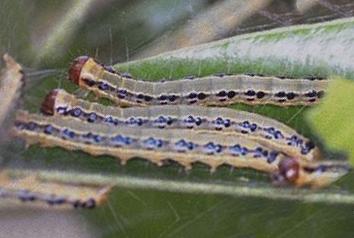
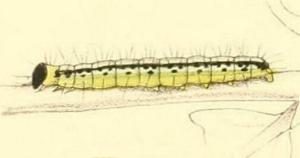
The caterpillars of this species are pale green with a broad knobbly black line along each side. Their head is dark brown.
These caterpillars have been found feeding on :
On the latter in south-east Asia: the caterpillars are a pest. The caterpillars live in a group in a shelter made by joining a number of leaves together with silk. The caterpillars drop on silk threads if disturbed.
When mature, the caterpillars descend and pupate in the soil.
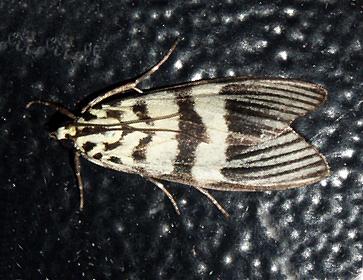
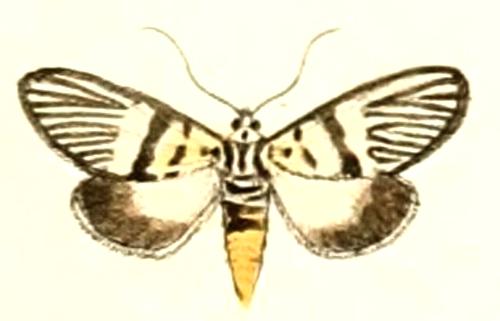
The adults have a striking pattern on the forewings of black on pale yellow. The hindwings are white with a broad black margin. The moths have a yellow and black banded abdomen. The wingspan is about 3 cms.
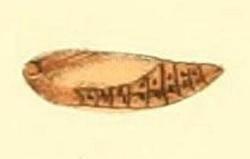
The eggs are yellowish-green, and are flattened. They are laid in an overlapping cluster, like tiles on a roof.
Control of the pest has being attempted using:
This species has been found across south-east Asia and the west Pacific, including
as well as in Australia in
Further reading :
Ian F.B. Common,
Moths of Australia,
Melbourne University Press, 1990, pl. 9.45, p. 354.
Frederic Moore,
The Lepidoptera of Ceylon,
L. Reeve, London, Volume 3 (1886), pp. 256-257, and also
Plate 178 figs. 3, 3a.
Buck Richardson,
Tropical Queensland Wildlife from Dusk to Dawn Science and Art,
LeapFrogOz, Kuranda, 2015, p. 29.
 caterpillar |  butterflies |  Lepidoptera |  moths |  caterpillar |
(updated 18 February 2010, 4 November 2025)