
| Rare Albatross (one synonym : Tachyris leucosticta Butler, 1898) PIERINAE, PIERIDAE, PAPILIONOIDEA | (donherbisonevans@yahoo.com) and Stella Crossley |
|
| Rare Albatross (one synonym : Tachyris leucosticta Butler, 1898) PIERINAE, PIERIDAE, PAPILIONOIDEA | (donherbisonevans@yahoo.com) and Stella Crossley |
The Caterpillar of this species is bluish-green and covered in small blue tubercles. It has a yellow line along the back. It grows to a length of about 3.5 cms. It feeds only on young shoots of:
and does not survive if only given older leaves.
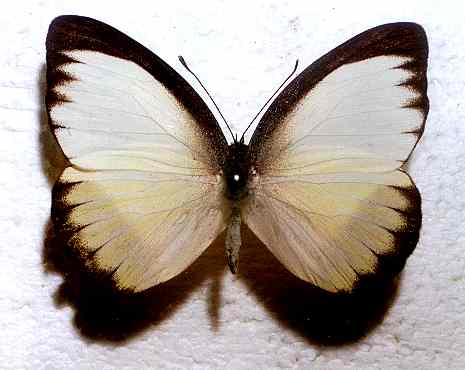
The adult butterflies of this species have a wingspan of about 5 cms. The upper surfaces of the forewings are white, each with a black costa and black spots along the margins. The hindwings are pale yellow with black margins.
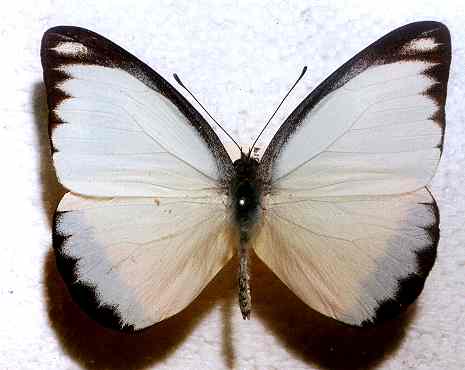
The males have a white spot in the black area near the apex.
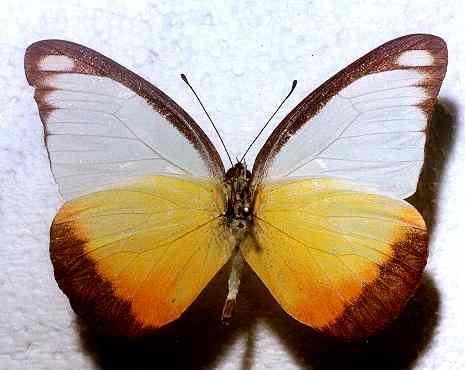
The undersides of the males and females are very similar. The undersides forewings are white with a black costa. The undersides of the hindwings are yellow with a broad black edge.
The eggs are laid singly on young shoots of a foodplant. They are spindle shaped, and initially white but changing to orange as they near hatching. They have a height of about 0.1 cm.
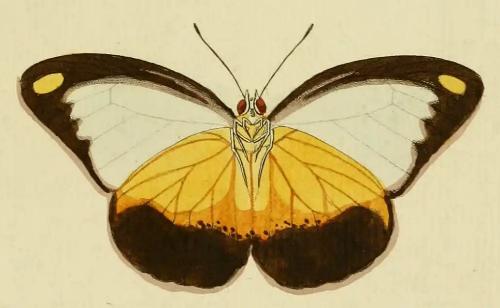
The species has been found as several subspecies across south-east Asia, including:
and as the subspecies caria Waterhouse & Lyell, 1914, in Australia in
Further reading :
Michael F. Braby,
Butterflies of Australia,
CSIRO Publishing, Melbourne 2000, vol. 1, p. 329.
Caspar Stoll,
Papillons exotiques,
in Pieter Cramer:
De uitlandsche kapellen, voorkomende in de drie waereld,
Volume 4 (1781), p. 142, figs. C,D, and also
Plate 363, figs C,D.
G.A. Wood,
The life history of Appias ada caria Waterhouse and Lyell
(Lepidoptera:Pieridae:Pierinae),
Australian Entomological Magazine,
Volume 13 (1987), pp. 5-6.
 caterpillar |  butterflies |  Lepidoptera |  moths |  caterpillar |
(updated 1 May 2009, 1 September 2026)