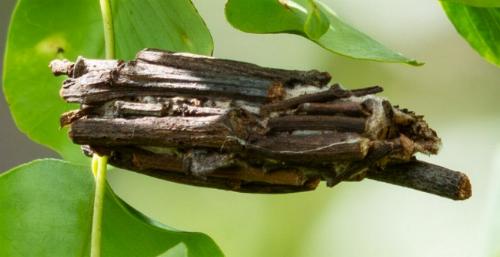
larval case,
Photo: courtesy Ethan Beaver,
Mitchell Plateau, Western Australia, from
Systematic revision of the Bagworm Moth genus Clania Walker 1855
(Lepidoptera, Psychidae, Oiketicinae) with thirty-four new species,
Zootaxa, Magnolia Press, Volume 5901 (2026), figure 7D.
These Caterpillars live and pupate in a silken case.
to which they attach adjoining twigs vaguely parallel to the axis of the case.
They often add one long stick to the case.

larval case, male, total length 10 cms.
Photo: courtesy Ethan Beaver,
Darwin, Northern Territory, from
Systematic revision of the Bagworm Moth genus Clania Walker 1855
(Lepidoptera, Psychidae, Oiketicinae) with thirty-four new species,
Zootaxa, Magnolia Press, Volume 5901 (2026), figure 5G.
For walking and feeding: the caterpillars normally only protrude the head and
thorax
out of the case,
as these are covered in a hard skin that is
coloured in a light and dark brown pattern.
The soft abdomen is kept inside the protective case.
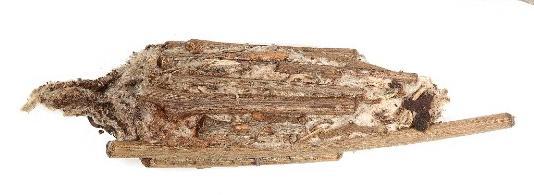
larval case, female, total length 5 cms.
Photo: courtesy Ethan Beaver,
Darwin, Northern Territory, from
Systematic revision of the Bagworm Moth genus Clania Walker 1855
(Lepidoptera, Psychidae, Oiketicinae) with thirty-four new species,
Zootaxa, Magnolia Press, Volume 5901 (2026), figure 5F.
The caterpillars have been found feeding on plants in
many plant families, including
ANACARDIACEAE,
FABACEAE,
LAMIACEAE,
LECYTHIDACEAE,
MIMOSACEAE,
MYRTACEAE,
SANTALACEAE.
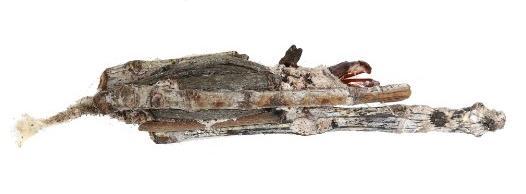
larval case with protruding empty pupal shell
Photo: courtesy of Ethan Beaver,
Darwin, Northern Territory, from
Systematic revision of the Bagworm Moth genus Clania Walker 1855
(Lepidoptera, Psychidae, Oiketicinae) with thirty-four new species,
Zootaxa, Magnolia Press, Volume 5901 (2026), figure 5E.
The adult male has translucent white forewings, each with a brown stripe along the
costa and along the
hind margin,
and very black lines along some veins.
The hindwings are translucent white with a brown stripe along the costa,
and brown veins.
The wingspan is about 4 cms.
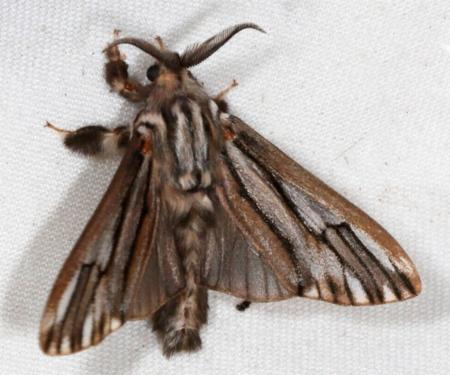
adult male,
Photo : courtesy of Dominic Funnell,
Rocky Point, Queensland, from
Systematic revision of the Bagworm Moth genus Clania Walker 1855
(Lepidoptera, Psychidae, Oiketicinae) with thirty-four new species,
Zootaxa, Magnolia Press, Volume 5901 (2026), figure 6B.
The thorax is covered in off-white hair scales
with three prominent black lines.
The adbdomen has a line of black hair scales along each side
The male moth has a long prehensile abdomen,
which is used to fertilise a female inside her case.
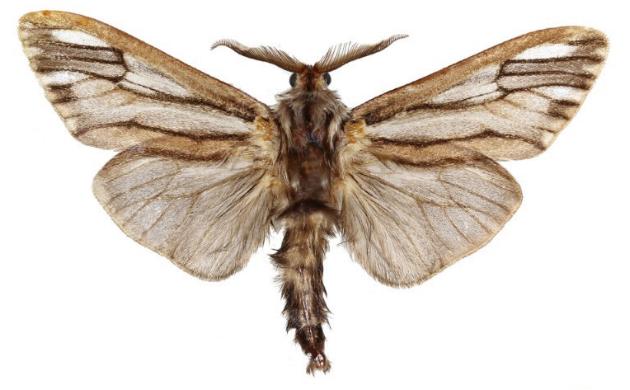
adult male,
Photo : courtesy of Ethan Beaver,
Carson Escarpment, Western Australia, from
Systematic revision of the Bagworm Moth genus Clania Walker 1855
(Lepidoptera, Psychidae, Oiketicinae) with thirty-four new species,
Zootaxa, Magnolia Press, Volume 5901 (2026), figure 3D.
The female is wingless.
She looks like a tubby off-white grub.
She stays inside the case, and is fertilised by a male inserting
the tip of his abdomen into the anal end of the case.
The species has been in Australia, in
Western Australia,
Northern Territory, and
Queensland.
Further reading :
Ethan P. Beaver, Thomas Sobczyk, Jonathan Wei Soong, Mengjie Jin,
Claire Yang, Elizabeth Broady, Jesse Wallace, Diana Hartley,
James A. Nicholls, & Andreas Zwick,
Systematic revision of the Bagworm Moth genus Clania Walker 1855
(Lepidoptera, Psychidae, Oiketicinae) with thirty-four new species,
Zootaxa, Magnolia Press
Volume 5901 (2026), pp. 19-20.
A. Jefferis Turner,
On some moths from Melville and Bathurst Islands in the South Australian Museum,
Transactions and Proceedings and Report of the Royal Society of South Australia,
Volume 38 (1914), p. 247-248.
(written 26 November 2026)