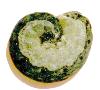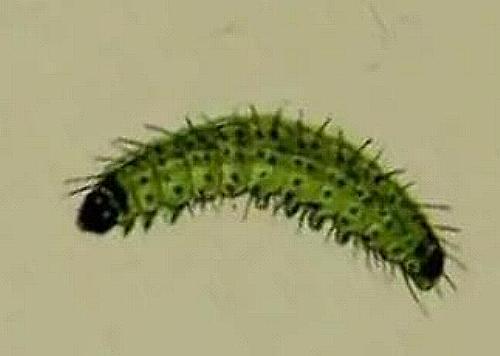
listed as Pterophorus isodactylus
illustration by Buckler, Wendel, and Trap,
The larvæ of the British butterflies and moths,
Ray Society, London (1910), Volume 9, Plate CLXIII, fig. 4,
image courtesy of Biodiversity Heritage Library,
digitized by Ernst Mayr Library, Harvard University.
These Caterpillars vary in colour from green to off-white,
with a pale or dark dorsal line.
The caterpillars have a pair of black tubercles above a black
spiracle on each side of each abdominal segment,
and each tubercle carries one short black hair.
The head and collar are black, as are the true legs
and the anal plate.
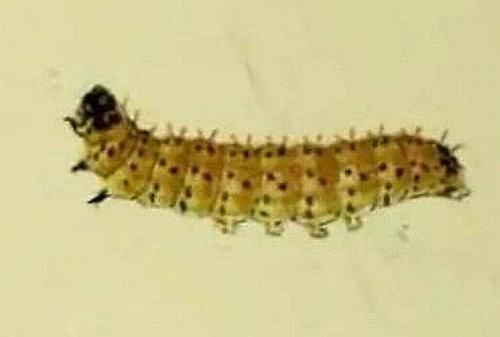
listed as Pterophorus isodactylus
illustration by Buckler, Wendel, and Trap,
(as above)
The caterpillars feed on plants in the family
ASTERACEAE, including
Marsh Ragwort ( Senecio aquaticus ),
Ragwort ( Senecio jacobaea ), and
Wood Ragwort ( Senecio ovatus ).
The caterpillars bore into the stems, and live and pupate in their borehole.
The caterpillars grow to a length of about 1 cm.
The pupa is off-white with a length of about 1 cm.
It is formed near the entrance to the borehole,
making it easy for the newly emerged moth to fly off.
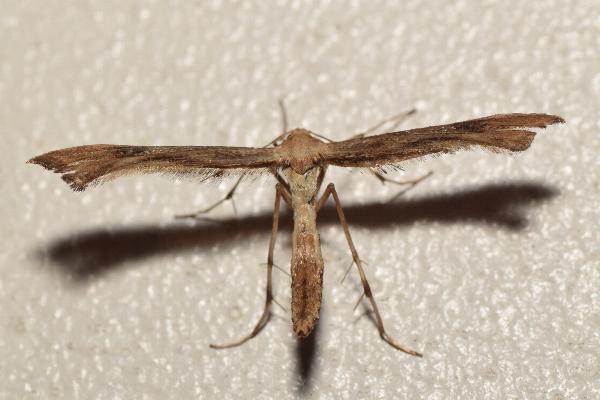
(Photo: courtesy of
Dianne Clarke, Kuratau, New Zealand)
The adult moth is brown with a dark mark
on each forewing, and has a wingspan of about 2.5 cms.
The species has been found is a native to Eurasia, including
China,
Denmark,
England,
Ireland,
Wales,
and in 1999, to control Ragwort, the species was introduced into
Australia,
and also into
New Zealand.
Further reading :
William Buckler,
The larvæ of the British butterflies and moths,
Ray Society, London (1910), Vol.9 (1901), pp. 343-347, and
Plate 163, fig. 4.
Philipp C. Zeller,
Revision der Pterophoriden,
Linnaea Entomologica,
Volume 6 (1852), pp. 328-330, No. 4.
(written 23 March 2019, updated 26 July 2026)