
| Gap-lined Pantydia EREBINAE, EREBIDAE, NOCTUOIDEA | (donherbisonevans@yahoo.com) and Stella Crossley |

(Photo: courtesy of Stephen Williams,
Moths of Victoria - Part 8)
|
| Gap-lined Pantydia EREBINAE, EREBIDAE, NOCTUOIDEA | (donherbisonevans@yahoo.com) and Stella Crossley |
(Photo: courtesy of Stephen Williams,
Moths of Victoria - Part 8)
The young Caterpillars of this species are pale green shading to pale brown at the head and tail.

The caterpillars have been found on
Later instars acquire a striped pattern.

The final instar is a patchy brown or dark grey, sometimes with some orange spots and lines. It has a dorsal nodule on the tail, and faint zigzag lines along each side, and a head that seems to have a white nose.

The caterpillar pupates in a cocoon spun in the ground debris.

The pupa is brown, and covered in a white greasy powder.

The adult moths are various shades of brown, with variable dark areas and a thin pale submarginal undulating line, not reaching the costa or hind-margin, on each forewing.

The moths have a wide crest behind the head with a black front.

The hindwings are plain pale brown. The wingspan is about 3 cms.

The eggs are grey and spherical, with minute grooves and dimples. They are laid in an untidy array on any convenient surface.

The moths have been found over much of Australia, including:

While most Pantydia can be separated by examining the underside of the hindwing, Pantydia diemeni can be recognized by the break in the forewing submarginal line.
Further reading :
Ian F.B. Common,
Moths of Australia,
Melbourne University Press, 1990, fig. 44.20, p. 450.
Achille Guenée,
Noctuélites,
in Boisduval & Guenée:
Histoire naturelle des insectes; spécies général des lépidoptères,
Volume 9, Part 6 (1852), pp. 437-438, No. 1309.
Peter Marriott,
Moths of Victoria - Part 8,
Night Moths and Allies - NOCTUOIDEA(B),
Entomological Society of Victoria, 2017, pp. 22-23.
 caterpillar |  butterflies | 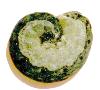 Lepidoptera |  moths |  caterpillar |
(updated 14 May 2013, 15 February 2023)