
| Australian Armyworm (one synonym : Pseudaletia evansi Holloway, 1977) HADENINAE, NOCTUIDAE, NOCTUOIDEA | (donherbisonevans@yahoo.com) and Stella Crossley |

(Photo: courtesy of the
Macleay Collection, Chau Chak Wing Museum, University of Sydney)
|
| Australian Armyworm (one synonym : Pseudaletia evansi Holloway, 1977) HADENINAE, NOCTUIDAE, NOCTUOIDEA | (donherbisonevans@yahoo.com) and Stella Crossley |
(Photo: courtesy of the
Macleay Collection, Chau Chak Wing Museum, University of Sydney)
This Caterpillar is brown, with a narrow dark-edged pale stripe along the back, and two dark-edged pale stripes along each side of the back. The pale stripes continue over the thorax. The head is stippled in black and brown, with a dark-edged pale triangular frons and a dark-edged pale dorsal stripe.

It is an agricultural pest, causing damage to pastures and crops. It hides by day, and feeds nocturnally on many plants, including :
They are called 'Army Worms' because of their habit of spreading out in a line across a lawn or pasture, and marching across it (somewhat slowly) consuming the foliage as they go.

The pupa is brown, and formed in a light cocoon in a cavity excavated just under the soil surface.

The adult moth has slender speckled rusty brown forewings with variable vague markings, each forewing usually with a black-edged white dot near the middle, next to a reddish smudge. Sometimes it has an angled submarginal line of dark dots. The hindwings are buff with dark veins and a broad dark margin. The hindwings have sinuous margins. The moth has a wingspan of about 4 cms.

The species is migratory, and has been found across most of Australia, including

Sightings in Australia identified as Mythimna separata are often actually Mythimna convecta. The adult moths are superficially only distinguishable by the undersides of the hindwings. Mythimna convecta has a broad black marginal band visible under each hindwing, whereas Mythimna separata has plain brown hindwing undersides.
Attempts to control the pest include :
Further reading :
Ian F.B. Common,
Moths of Australia,
Melbourne University Press, 1990, fig. 50.2, pp. 45, 56, 59, 65, 466.
Peter Marriott & Marilyn Hewish,
Moths of Victoria - Part 9,
Cutworms and Allies - NOCTUOIDEA (C),
Entomological Society of Victoria, 2020, pp. 25, 28-29.
Francis Walker,
Catalogue of Lepidoptera Heterocera,
List of the Specimens of Lepidopterous Insects in the Collection of the British Museum,
Part 11 (1857), p. 711.
 caterpillar |  butterflies | 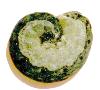 Lepidoptera |  moths |  caterpillar |
(updated 12 January 2013, 19 February 2026)