
| (previously known as Nygmia arrogans) LYMANTRIINAE, EREBIDAE, NOCTUOIDEA | (donherbisonevans@yahoo.com) and Stella Crossley |
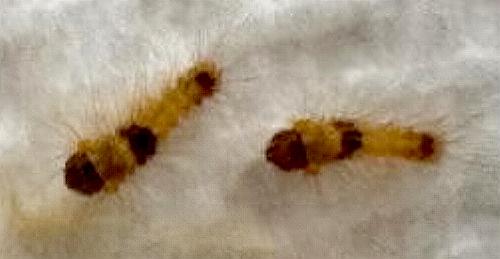
early instars
(Photo: courtesy of
Annabel Taylor,
Hillsborough, Queensland)
|
| (previously known as Nygmia arrogans) LYMANTRIINAE, EREBIDAE, NOCTUOIDEA | (donherbisonevans@yahoo.com) and Stella Crossley |
early instars
(Photo: courtesy of
Annabel Taylor,
Hillsborough, Queensland)
The early instars of this species are yellow and hairy. They have a dark brown head, and dark brown first and last abdominal segments.
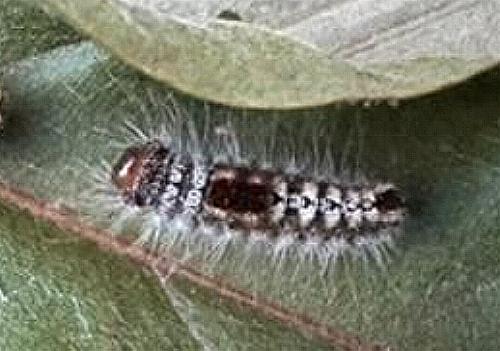
Later instars become black with pairs of white markings on the back of the thorax and the abdominal segments, except that segments 1, 2, and 8 develop black tufts. The head is dark brown, and is often tucked under the thorax.
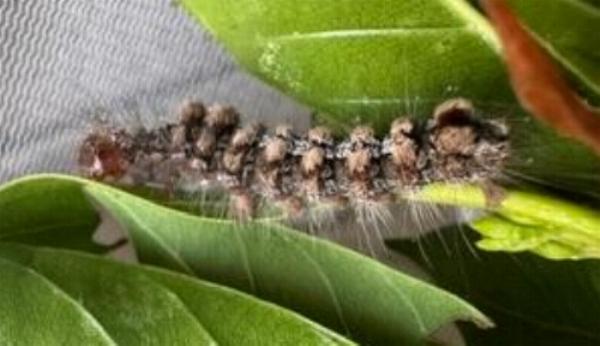
The caterpillars have been found feeding on
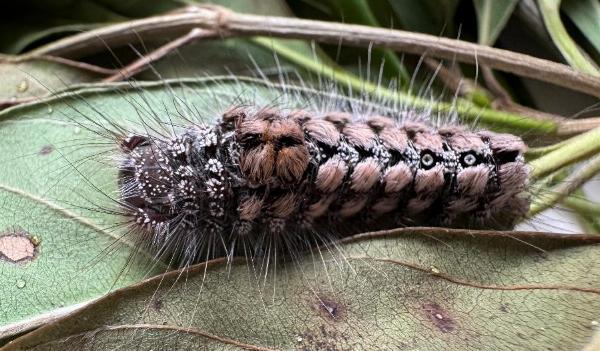
Final instars develop pairs of warts on the back of each segment with pale hairs, with larger warts and darker hairs on the first two segents.
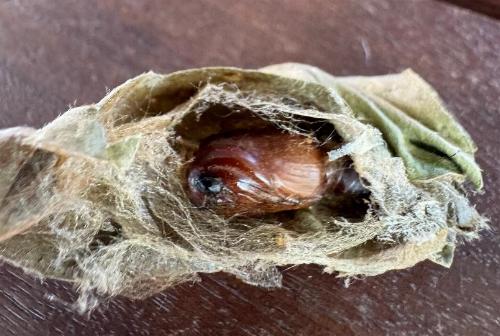
The caterpillars grow to a length of about 6 cms. They pupate in a loose cocoon in a curled leaf of the food plant.
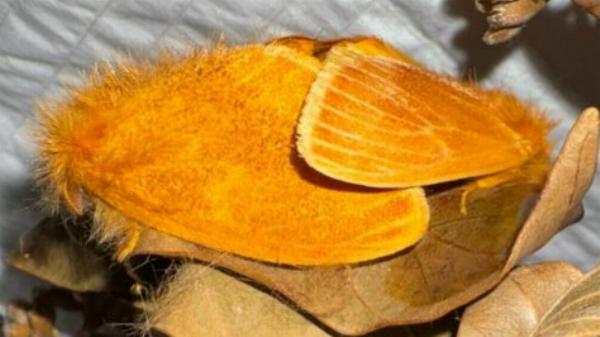
The adult moth has orange-brown forewings each with a shaded marginal half. The scales are only loosely held on the wings, so some specimens have pale marks where scales have rubbed off. The hindwings are paler than the forewings. The female moth has a wingspan of about 6 cms. The male moth has a wingspan of about 4 cms.

Some specimens have two faint pale lines across each forewing. The hindwings are paler than the forewings. The moth has a wingspan of about 5 cms.

The species has been found in:
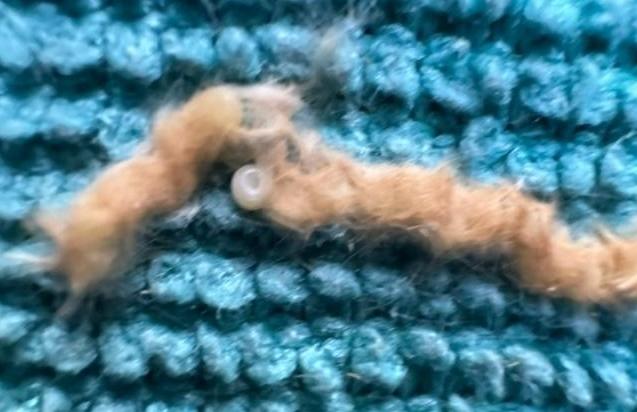
The eggs are white spheres, each with a dimple in the top, and have a diameter of about 0.5 mm. They are laid on any convenient surface, about a dozen at a time, in a line, and are covered in brown abdominal hairs by the female.
Further reading :
Thomas P. Lucas,
New species of Queensland Lepidoptera,
Proceedings of the Royal Society of Queensland,
Volume 15, Part 4 (1889), p. 140.
 caterpillar |  butterflies |  Lepidoptera |  moths |  caterpillar |
(updated 11 February 2010, 11 July 2026)