Graphium eurypylus (Linnaeus,1758)
PAPILIONIDAE
Pale Green Triangle Butterfly
Don Herbison-Evans (
donherbisonevans@yahoo.com )
&
Stella Crossley

Don Herbison-Evans (
donherbisonevans@yahoo.com )
&
Stella Crossley
This species is probably named after Eurypylus of Ancient Greece, quoted in the Aeneid as bringing a dire message to the Greeks in their war with Troy. Subsequently, he was murdered by Odysseus.
These Caterpillars start life as white, yellow, or greenish round eggs which are laid singly on the new shoots of a food plant. They are often found feeding on plants in the family ANNONACEAE, such as:
although the Caterpillar only seems to flourish on the Soursop. Other foodplants reported are :
as well as

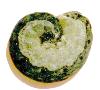
The Caterpillars are black at first with a pale yellow forked tail. They are rather kite-shaped, being hump-backed in the thoracic region, and tapering from the metathorax rearward.

As they grow they become brown and later green.

The metathorax develops a spike each side, which in later instars is dark blue. A pair of dark spikes also develop on the head. A white set of flaps develop along the sides, like a white skirt. When disturbed, the Caterpillar everts a transparent pale yellow osmeterium, and produces a strong aromatic odour. The Caterpillar grows to a length of about 4 cms.

The pupa has a blunt thoracic horn, and is pale green with rows of darker green dots along each side. It has a length of about 2.5 cms.

The adult is black with pale turquoise patches and spots. The underside also has some red spots.

The butterfly has a wingspan of about 6 cms.
Races of this species are found throughout south-east Asia, and three subspecies have been recognised in Australia:

Butterflies of this species may be purchased for release at weddings etc.
Further reading :
Michael F. Braby,
Butterflies of Australia,
CSIRO Publishing, Melbourne 2000, vol. 1, pp. 260-262.
 caterpillar |
 butterflies |
 caterpillars |
 moths |
 caterpillar |
(updated 11 November 2009)